
Square Fire water tank NFPA 22
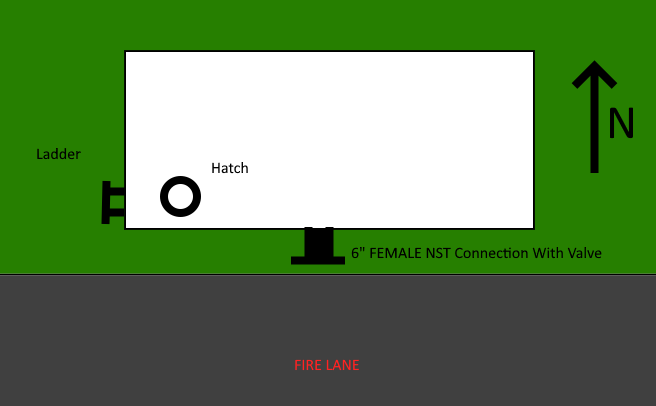
Application: Static fire water tank – fire department drafting (truck suction)
Location: Houston-area climate (rare freeze events)
System Type: No sprinkler system, no fixed fire pump
Minimum Usable Volume: 83,300 L (22,000 US gallons)
1. Purpose / Use
The tank shall serve as a static fire water storage tank.
In the event of a fire, a fire department pump truck will park adjacent to the tank and draft water directly from the tank.
There is no sprinkler system connected to this tank.
There is no permanently installed fire pump connected to this tank.
The tank shall be dedicated exclusively to fire protection use.
No domestic, irrigation, process, or makeup water connections are permitted.
2. Applicable Standards
The tank design, construction, and appurtenances shall explicitly comply with the following standards:
NFPA 22 – Water Tanks for Private Fire Protection
NFPA 1142 – Water Supplies for Suburban and Rural Fire Fighting
Requirements:
The edition year of each standard shall be clearly stated on all drawings.
“Designed with reference to” or “NFPA considered” language is not acceptable.
Compliance shall be explicit and complete.
3. Tank Geometry, Orientation & Layout (MANDATORY)
Tank internal geometry:
Length (East–West): 8.0 m (26.2 ft)
Width (North–South): 4.0 m (13.1 ft)
Water height: 3.0 m (9.8 ft)
Tank orientation:
The 8.0 m dimension shall run East–West
The 4.0 m dimension shall run North–South
Minimum usable volume shall be achieved within these dimensions.
4. Tank Construction
Tank construction type:
PLEASE QUOTE FOR:
Carbon Galvanized Steel (bolted/panelized)
Stainless Steel (bolted/panelized)
Fiberglass (bolted/panelized)
Square / rectangular tanks are permitted, provided they are fully structurally engineered.
Tank shall be designed for:
Full hydrostatic load
Empty condition uplift
Wind loads
Seismic loads in accordance with IBC / ASCE 7
Structural calculations shall be provided and sealed by a Professional Engineer.
Materials shall be clearly specified:
Plate thickness
Bolt size and grade (if bolted)
Gaskets
Interior liner or coating system
5. Foundation & Anchorage
A designed foundation or slab shall be provided.
Anchorage shall be designed for:
Sliding
Overturning
Uplift
Soil bearing assumptions shall be stated.
Tank-to-foundation interface shall be fully detailed.
6. Water Capacity
Total geometric volume shall be stated.
Usable fire water volume shall be clearly defined.
Minimum operating water level shall be identified.
Low water level shall not impair drafting or suction.
Volume shall be consistent with NFPA 1142 fire flow duration requirements.
7. Suction Outlet (CRITICAL REQUIREMENT)
A dedicated fire department suction outlet shall be provided.
Outlet size:
6-inch (150 mm) female NST (National Standard Thread)
Outlet location:
Installed on the south side of the tank
Located approximately at the center of the south wall
Outlet arrangement shall:
Be suitable for fire department drafting
Be protected from physical damage
Outlet piping:
Rigid steel
Internally supported
Provided with debris protection (strainer or screen)
8. Anti-Vortex Provisions (MANDATORY)
The tank shall include explicit anti-vortex provisions in accordance with NFPA 22.
Acceptable devices include:
Vortex plate
Tee arrangement
Elbow diffuser
Perforated plate
Minimum water submergence shall be dimensioned on drawings.
Anti-vortex geometry shall be shown in detail.
Statements such as “no vortex expected” are not acceptable without geometry.
9. Fire Department Access
Tank shall be located within 15 ft (4.6 m) of a fire lane.
Fire apparatus shall be able to:
Park
Connect
Draft without obstruction
Suction connection height shall be usable by fire department apparatus.
Connection shall be clearly visible and accessible.
10. Venting
Atmospheric vent shall be provided.
Vent shall be sized to:
Prevent vacuum during drafting
Prevent overpressure during filling
Vent shall be protected with:
Screen
Weather hood
Vent shall be designed to resist blockage from debris or freezing.
11. Overflow
Overflow piping shall be provided.
Overflow shall be sized for the maximum fill rate.
Overflow discharge shall route to a safe location.
Overflow shall not flood the foundation or fire lane.
Overflow outlet shall be protected from blockage.
12. Drain
Tank drain shall be provided.
Drain valve shall be accessible and protected.
Drain discharge shall route to a safe location.
Drain shall not impair fire water availability.
Drain shall be protected from accidental operation or freezing.
13. Access & Inspection
Manway(s) shall be provided for internal access.
Manway size shall permit human entry.
Ladder:
External ladder shall be installed on the WEST side of the tank
Safe inspection access shall be provided.
Fall protection shall be included where required.
14. Roof / Cover
Tank shall include a roof or cover.
Roof shall prevent:
Debris entry
Animal entry
Roof shall be designed for:
Wind loads
Maintenance loads
All roof penetrations shall be sealed.
15. Corrosion Protection
Interior lining shall be compatible with stored fire water.
Exterior coating shall be suitable for Houston-area environmental exposure.
Dissimilar metals shall be addressed.
Corrosion allowance shall be stated.
16. Freeze Protection (Houston Climate)
Freeze protection strategy shall be defined, such as:
Insulation (NOT REQUIRED - DO NOT QUOTE)
Buried piping (NOT REQUIRED - DO NOT QUOTE)
Drainable suction piping
No reliance on continuous heating unless explicitly approved.
Fire department suction shall remain usable during rare freezing events.
17. Identification & Signage
Tank shall be permanently labeled “FIRE WATER”.
Water volume shall be posted if required by the AHJ.
Drafting instructions shall be provided if requested by the fire department.
Tank shall not be confused with any domestic water system.
18. Testing & Acceptance
Hydrostatic leak testing shall be performed.
Visual inspection shall be conducted.
Verification shall include:
Suction operation
Venting
Overflow
As-built drawings shall be provided.
19. Required Manufacturer Submittals
The manufacturer shall provide:
General arrangement drawings
Foundation Design/Drawing with loads
Structural calculations
Suction outlet details
Anti-vortex details
Vent and overflow sizing
Material specifications
Coating/liner data
Explicit written statement of compliance with NFPA 22 and NFPA 1142